 Silly Amélie, are you french or feminist?
I thoroughly enjoyed "Amélie", it was different, funny, not-too-long, and had a happy ending. But throughout the movie, I was puzzled:
C'est un film Français? Or does this go under the independent, free-thinking, and "WOMEN ARE POWERFUL, DON'T MESS WITH US" category?
Well, at least I knew something was different about this movie.
So how can this film be classified as "French"? Let's take the presentation style of the movie. We've got the narrator (voiced by André Dussolier) who's voice is predominant in the first few scenes of the movie: Amélie as a child. The quick shots of Amélie's curious cases and mischievious acts (increased heart rate when her father checks up on her and unplugging her neighbor's television reception) combined with Dussolier's rapid and direct narration provide a humorous insight for the viewer into Amélie's life. This connection shared between the silver screen and the audience is a very common feature in other French films.
 Amélie and her shenanigans
We've also got the obvious "It takes place in France so it must be French" argument and an even much more similar "They speak in French" insight.
And we can take two sides to this argument.
1.) Yes, this film does take place in France, and yes, they do speak French. It is authentic, it shows how REAL French people live in the suburbs of Paris and outside Montmartre. The film fails to show any of the popular tourist attractions in Paris, save the Sacre Couer (if you're in Montmartre, you just can't miss the Sacre Couer), so this possibly couldn't be some Hollywood flick. And did I mention that they're all speaking French?
2.) Just because a film takes place in a foreign land doesn't make it from that place. "The Sound of Music" isn't an Austrian film, and "Vicky Cristina Barcelona" is no Spanish flick. Hollywood films have their own characteristics, no matter where they are filmed. On that same note, so do French films. What do "Mercredi, folle journée (Wacky Wednesday transl.)" and "Amélie have in common? Use of a reliable narrator, slower plotlines, happy endings, and stronger character development.Well, at least I knew something was different about this movie.
So how can this film be classified as "French"? Let's take the presentation style of the movie. We've got the narrator (voiced by André Dussolier) who's voice is predominant in the first few scenes of the movie: Amélie as a child. The quick shots of Amélie's curious cases and mischievious acts (increased heart rate when her father checks up on her and unplugging her neighbor's television reception) combined with Dussolier's rapid and direct narration provide a humorous insight for the viewer into Amélie's life. This connection shared between the silver screen and the audience is a very common feature in other French films.
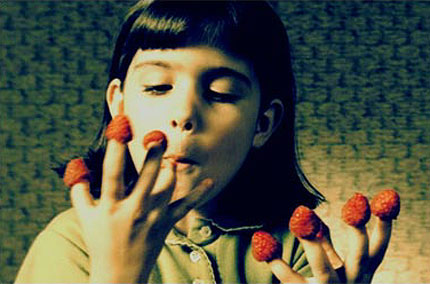 Amélie and her shenanigans
And we can take two sides to this argument.
1.) Yes, this film does take place in France, and yes, they do speak French. It is authentic, it shows how REAL French people live in the suburbs of Paris and outside Montmartre. The film fails to show any of the popular tourist attractions in Paris, save the Sacre Couer (if you're in Montmartre, you just can't miss the Sacre Couer), so this possibly couldn't be some Hollywood flick. And did I mention that they're all speaking French?

300: It's about Spartans and war, of course it goes under "Greek Film" category!
Essentially it doesn't matter where the film is made. However, it should include the predominant characteristics and cultural references associated with its respective country. It should also abide by the details associated with it's history in cinema.
Sure, Amélie does a great job of depicting a French film, but couldn't it also be seen as a feminist work?
Well what constitutes a feminist work? Feminist film entails the development of a woman's self reliance, sexual freedom, and liberal perspective on life. Feminist film (obviously) frames the woman as the center of attention, the main and only focus of the film. All other characters (men) are relatively insignificant, or play the role of the "bumbling idiot always outsmarted by the woman".Amélie was the main character, therefore making her the center of attention. Check.
Nearly all men shown in the film were bumbling idiots:
Nino Quincampoix (Amélie's lover)- Is frequently seen sweeping his hand under photobooths in subways to pick up scraps of pictures, which he then puts together and collects in an album.

Are you sure you're not Amelie? You look just like her I swear!
Raphael Poulain (Amélie's father)- Becomes obsessed with decorating his dead wife's shrine in the backyard, as well as a garden gnome that is stolen and taken around the world. Travelocity gnome?
Mr Collignon (grocery shop owner)- Is tricked into using foot cream for toothpaste, drinks tampered whiskey, and doesn't realize Amélie is getting back at him for mistreating his employee.
 Quoi? I swear I didn't change the doorknobs!
Bumbling Idiots. Check.
Amélie herself is shown as an independent and free-thinking young woman. She lives alone in an apartment in France. She takes joy in the little things in life, and enjoys playing the role of matchmaker. She is constantly in search of love, but when the opportunity arrives she is too afraid to confront. This sort of confused conflict could very well be something that could characterize this film as feminist.
So, is "Amélie" a French film or a feminist film?
Technically, it's a French film. The French culture and French film style is much more deeply explored in "Amélie" than the "feminist" ideals. However, one could make a strong argument that it is both a French film AND feminist, resulting in the category FRENCH FEMINIST FILM.
One can only agree that "Amélie" is a truly unique, quirky, and entertaining film.


Dropping by to check out your blog..very nice.
ReplyDeleteDorothy from grammology
grammology.com