The Celluloid Closet, a documentary film based on a book written by Vito Russo gives a very distinct depiction of how gay, lesbian, bisexual, and transgender characters are portrayed in film. The film focuses mainly on men and women that were at some point related to Hollywood. The film relies on the stories of a series of directors, writers, and actors who sympathies with the homosexual community. The men and women tell their stories of how they incorporated subtle homosexual comments or actions into their films. Many of these almost insignificant actions impacted the homosexual and anti homosexuals communities in that they were finally were seen as more acceptable. The movie shows how Hollywood had portrayed these individuals and how sexually free people had been viewed by the world. There were even laws enacted in order to prohibit sexual interaction between same sex individuals on screen. This all began to change as social awareness to the ever present influence of gay, lesbian, bisexual, and transgender actors and directors in Hollywood had on the multitude of viewers who watched their films. The directors began to use these subtle remarks encouraging homosexuality in order educate the public on homosexuality and it’s characteristics. I feel this film was designed as sort of a wake up call to society so that the homosexual audience would have more respect in the Hollywood industry. It opened up new venues for future actors and directors to improve on the techniques used in this film. Through this film we also begin to realize how directors and actors in the past have been steadily showing homosexuality in film for a very long time. This helps with accomplishing the ultimate goal of society as a whole accepting the culture as its own. I have a clip from the Celluloid Closet which accurately depicts some subtle and some more evident hints at homosexuality.
Joel Revis
Sunday, November 15, 2009

Friday, November 13, 2009
Transitions in Fancydancing

The movie The Business of Fancydancing contains a great variety of scenes from many times, often not in chronological order. This can cause a little confusion to the audience at first, but as the movie progresses, it is easier to comprehend what is happening. Further complicating the movie are very unusual transitions. Sometimes the movie just cuts to different scenes, while other times it shoes the main character dancing in what appears to be some sort of a void. He is also dressed in traditional clothing. These transitions are relatively similar, with the exception of the last one, in which he stops and takes apart his traditional clothing, signaling that he is finished. The transitions are used to compliment the narrative, showing, in a way, the progress of his feelings throughout the movie. When he finally leaves the reservation, he removes his traditional clothing.
Thursday, November 12, 2009
That Little Place in London...

Sarah Gavron’s ‘Brick Lane’ is the story of a woman from Bangladesh, who after the death of her mother, is sold by her father in an arranged marriage to a man in the Brick Lane district of London. The story focus around the main character’s, Nazneen, loss of a childhood, which she tries to regain in the letters she reads from her sister back in Bangladesh. The search of escape through letters is very similar to the strategy used in the book The Color Purple, as a depressed housewife again uses the letters of her sister to attempt to escape the world she is forced into. Seeing both the book and movie both have feminist undertones, Gavron may have piggybacked off this idea a bit.
Nazeen’s desire for passion finally leads her to the main point of conflict in the story, the affair with Karim. The desire to regain some control in her life and live the dreams she has read time and time again in her sister’s letters drives her to go behind the back of the man she has been with since being relocated to London and seek a new passion, found in Karim.
One Badass Chick

With the rise of the feminist movement in the 1970’s a new way of analyzing film was introduced to the world. Women were now demanding that the role they had played in film history be noticed and were stepping out from behind the shadows of the dominating male role. As described in The Oxford Guide to Film Studies, where women were once kept from the main focus of the story and there to compliment the leading male’s role, they now began to take the spotlight and demand the attention. A recent example of this can easily be seen in Ridley Scott’s 1979 ‘Alien’. In this movie, the dominance of a female role, as seen in Sigourney Weaver’s character Ripley, cast a shadow over all other main characters. Perhaps there is just something invigorating to an audience to see a badass woman with a huge flamethrower. This emergence of the female heroine in popular media was a huge victory from the standpoint of feminist in Hollywood.
David Scully
Stereotypes Galore!

Paul Haggis’ 2004 movie ‘Crash’ films the story of a car jacking and the related events to it from the multiple views of the characters involved. As the story unfolds we find ourselves in a story filled with racism and racial stereotypes. The stereotypical roles begin early in the story when the District Attorney of Los Angeles, Rick Cabot, and his wife, Jean Cabot, are carjacked. Surprise! The carjackers are both black. The event leaves Jean very uncomfortable with minorities, and when they decide to change their locks on their house she is untrusting of the a Mexican-American locksmith, Daniel Ruiz, who changes the locks and insist that they be changed again the following day. Daniel Ruiz himself is pointed out just because of his outward appearance. He looks to be a sketchy character that lives a rough life, but beyond the initial prejudice, he is actually a loving family man who puts the good of his family above all else. The head carjacker, Anthony, is aware of the negative stereotypes placed on blacks. He is very vocal about the distaste he has for the image that goes along with the black community; yet, he falls right back into the stereotypical life of crime and violence. The inverse of Anthony is Detective Graham Waters, the older brother of Anthony’s partner Peter. Graham is the product of a broken home: his brother is deeply involved in crime and his mother is addicted to drugs. Detective Waters seeks to rise above his shadowy upbringing and now works to make the world a better place. Finally, we have the image of the Persian shop owner, Farhad. Farhad is viewed as an outcast by those around him, and is mistaken by others as an Arab. This places the false label of a terrorist onto Farhad, and with his natural bitterness and short temperedness, he plays into the role very well.
David Scully
Tuesday, November 10, 2009
Women in Action Movies!

Throughout the history of cinema there have been thousands of action movies starring hundreds of males in protagonist roles. The number of women playing these roles is substantially smaller. This is because until the 1970’s, women were not chosen to play these roles by directors. Some thought women were not suited to do the sorts of things men did in action movies, while others thought that this would not attract the masses of movie-goers they aimed to attract. This pattern was eventually broken by the rebellious 70’s directors who promptly hired women to play roles as action heroes, fighters, and defenders of people. Movies such as the popular Terminator showed a female fighting against fierce odds in horrible conditions. The incredible success of these movies proved to everybody that gender was not a determining factor in the success of a movie. They set precedents for thousands of movies to come. Even though men are used more often in these types of roles, women are becoming increasingly seen in these settings. One example is the successive terminator movies. Every terminator movie has features a female in a very important role.
A Gay Native American Movie W/out Queer Theory

The Business of Fancydancing: essentially it's a movie about an openly gay Native American poet who goes back to his reservation to attend a funeral. The movie analyzes the different struggles Polatkin (the poet) endures in both the urban city life and back home at his reservation. It's interesting to see how the movie doesn't portray his struggles as a homosexual man, rather, as a successful Native American poet. This movie seems to ignore queer theory for that matter. If the movie did not show the scenes of Polatkin sleeping or dancing with his boyfriend, then this movie would just be labeled as just another movie about Native American opression in today's day and age.
But we should still look at this movie for the message it tries to convey: Remembering your roots. Sherman Alexie (Director) depicts Polatkin speaking at several events, recalling his childhood and lifestyle growing up on the reservation. But the moment he goes back to visit, everyone harbors negative feelings toward him. What is dissapointing about Polatkin's attitude is that he doesn't seem to realize how much he ignored his roots, instead says that living on the reservation was "enough". This is truly apparent when he gets into an argument with one of his cousins on the back porch of his deceased friend's home. His cousins agree that Polatkin has done nothing to show his pride and heritage except "mention them" in his works, but he has never come back and been a part of their culture.
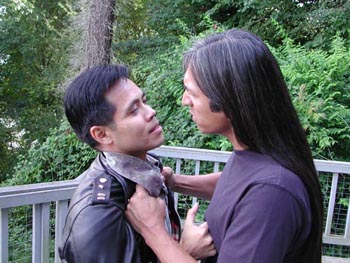 The Argument
I would categorize this film as "Native American culture", rather than "Homosexuality".
Thursday, November 5, 2009
Feminism and Culture

Brick Lane is a modern take on the hardships placed upon a woman forced to marry someone whom she did not know. The very beginning of the movie shows just how difficult it can be for women to cope with the issues of unequal treatment in a male dominated society by showing Nazneen’s mother commit suicide. Shortly later, Nazneen finds herself in a situation all too similar to that of her mother. Her husband is portrayed as cruel and unfeeling, allowing her almost no happiness. She does, however, begin to find happiness by changing her lifestyle to a more ‘modern’ lifestyle by starting work, going out more alone, and even cheating on her husband. This shows how new freedoms created by western cultures can liberate women from some of the hardships they face elsewhere. Also, her husband changes throughout the film, also adapting to the culture and becoming more respectable. Is this film advocating the use of westernized cultures, arguing that they provide more freedoms and overall better lives for women? Throughout most of the movie Nazneen wishes to return home, but, when given the chance, chooses not to.
Sunday, November 1, 2009
James Bond is the British John Wayne


It was only a few months ago when I saw my first Sean Connery "James Bond" flick. Sure, I had seen Daniel Craig represent 007 in the last two "Bond" movies, but I had never taken the time to see one of the 'classics'.
It was interesting watching an action-packed film with not too many 'michael-bay-esque' explosion sequences. This movie actually had a great plot, character development, and enough action to keep you at the edge of your seat.
But then I got thinking, is the "007" series the equivalent of our American Western movies?
I'm sure Her Majesty would be insulted.
But just you wait, before you off and read some other film critic's blog, hear me out for a second:
John Wayne in The Searchers. Retired Civil War soldier takes matters into his own hands after his niece is stolen by the evil 'injuns".
James Bond in Goldfinger. MI6 agent asked to look into a gold fanatic's suspicious activity, who happens to be helped out by some Asian henchmen.
We can also analyze the romantic aspect of Western and Bond movies. The Searchers isn't the best example, but several other Western flicks are very similar to the Bond movies when dealing with romance.
Plot lines have the same basic format: the hero is just taking a break from his stressful-saving-the-world life, when all of a sudden, some jerk is startin' up trouble in the neighborhood.
The semi-racist hints are all present: In The Searchers it was the Native Americans, in Goldfinger it was the Asian assistants (including the ever famous Oddjob).
And last but not least, we can't forget the action-packed sequences. Gun fights are what draws people to watch these movies. Loyal horses in Westerns are equally comparable to Bond's Aston Martin or Maserati.
John Wayne in The Searchers. Retired Civil War soldier takes matters into his own hands after his niece is stolen by the evil 'injuns".
James Bond in Goldfinger. MI6 agent asked to look into a gold fanatic's suspicious activity, who happens to be helped out by some Asian henchmen.
We can also analyze the romantic aspect of Western and Bond movies. The Searchers isn't the best example, but several other Western flicks are very similar to the Bond movies when dealing with romance.
Plot lines have the same basic format: the hero is just taking a break from his stressful-saving-the-world life, when all of a sudden, some jerk is startin' up trouble in the neighborhood.
The semi-racist hints are all present: In The Searchers it was the Native Americans, in Goldfinger it was the Asian assistants (including the ever famous Oddjob).
And last but not least, we can't forget the action-packed sequences. Gun fights are what draws people to watch these movies. Loyal horses in Westerns are equally comparable to Bond's Aston Martin or Maserati.
But most importantly, the good guy always wins and lives.
Westerns and spy movies are similar most likely due to the fact they include lots of action packed sequences and easy storylines to follow.
So yes, the 007 flicks are Britain's form of the shoot-'em-up Western.
So yes, the 007 flicks are Britain's form of the shoot-'em-up Western.
God Save the Queen Y'all.
Subscribe to:
Posts (Atom)